Car Insurance Cost in 2026: State, Age & Vehicle Guide
Key Highlights
- •What is the average cost of car insurance in 2026?
- •Why is car insurance more expensive in some states?
- •What is the cheapest car to insure in 2026?
The national average cost of car insurance in the U.S. is about $2,900 a year (~$244/month) for full coverage, and roughly $1,570 a year (~$131/month) for state-minimum liability-only coverage. That average hides a huge range: your actual premium depends heavily on your state, your age, and the car you drive, sometimes by a factor of three or more.
Quick Answer
Full coverage averages $2,926/year nationally; minimum coverage averages $1,572/year. Your state alone can swing this by $2,800+.
Age matters more than almost anything: a 16-year-old pays roughly 6x what a driver in their 50s pays for the same coverage.
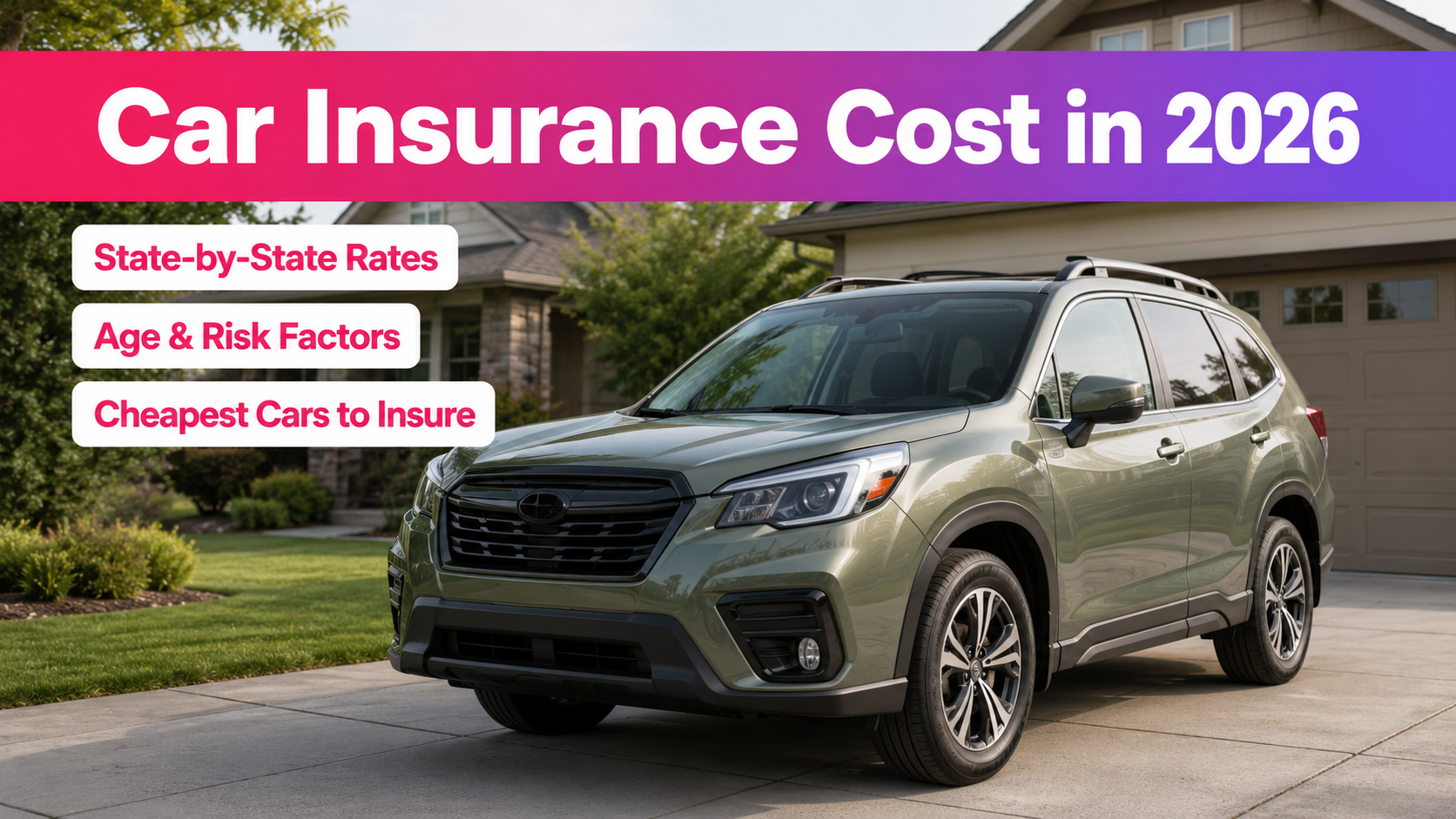
The car you buy changes the bill too: the cheapest models to insure (Subaru Forester, Chrysler Pacifica) run about $100-102/month, versus $244/month average.
National Average Car Insurance Cost in 2026
According to ValuePenguin and U.S. News, full coverage insurance runs about $2,926/year nationally, while a bare-bones state-minimum policy averages $1,572/year. Most drivers land somewhere in between depending on their deductible, coverage limits, and add-ons like roadside assistance or rental reimbursement.
Car Insurance Cost by State (Cheapest vs. Most Expensive)
Where you live matters more than almost any other factor. States with higher accident rates, more lawsuits, higher theft rates, or minimum-coverage requirements tend to cost the most. Here's how the extremes compare for full coverage:
State | Avg. Annual Cost | Rank |
|---|---|---|
Maryland | $4,222 ($352/mo) | Most expensive |
New York | $4,031 ($336/mo) | 2nd most expensive |
Louisiana / Florida | $3,600+ ($300+/mo) | Top 5 most expensive |
Vermont | $1,404 ($117/mo) | Cheapest |
Maine / New Hampshire | ~$1,500-1,550 (~$125-129/mo) | Among cheapest |
Maryland is the most expensive state for car insurance in 2026, averaging $4,222 a year, while Vermont is the cheapest at $1,404 a year. That's roughly a $2,800/year gap between the cheapest and priciest states for the exact same driver profile, which is why comparing quotes from your specific state matters far more than any national average.
Car Insurance Cost by Age
Age is one of the biggest cost factors, mainly because it correlates directly with crash risk. Per IIHS fatality data, drivers aged 16-19 are involved in fatal crashes at more than 3 times the rate (per mile driven) of drivers 20 and over, and MoneyGeek data shows that risk translating directly into premiums.
Age 16 (highest risk): ~$10,400/year full coverage (often $230-$457/month)
Ages 20-25 (young adult): ~$1,825/year (roughly $152/month on average)
Ages 40-60 (middle-aged): ~$1,130-$1,225/year (roughly $94-$102/month)
Ages 50-65 (lowest risk bracket): ~$1,125-$1,165/year (roughly $94-$97/month)
In practice, a driver's cost drops sharply between 16 and 25 as they build a clean record, then stays fairly flat until it ticks back up slightly after 65-70 in some states.
Cheapest Cars to Insure in 2026
The vehicle itself changes your premium too. Insurers price based on repair cost, safety ratings, theft rates, and how often a model gets in claims, and compact SUVs with strong safety scores and cheap parts consistently insure for less. The Subaru Forester is the cheapest car to insure in 2026, averaging about $100 a month for full coverage.
Model | Avg. Monthly (Full Coverage) | Why It's Cheap |
|---|---|---|
Subaru Forester | ~$100 | Top safety scores, low theft rate |
Chrysler Pacifica | ~$102 | 26% below national average |
Honda CR-V | ~$161 | Cheap parts, strong reliability |
Subaru Crosstrek | ~$165 | Low claims frequency |
Jeep Wrangler | ~$170 | Lower average repair severity |
On the flip side, sports cars, luxury EVs, and anything with a high theft rate or expensive body panels (think large touchscreens, aluminum panels, ADAS sensors) will push your premium well above average, and it's worth checking before you buy, not after.
How to Lower Your Car Insurance Premium
The good news: insurance is one of the few car ownership costs you can meaningfully shrink without changing your driving habits or your vehicle. A few things actually move the needle:
Shop at least 3 quotes: the same driver can see rates vary by hundreds, sometimes thousands, of dollars a year between insurers for identical coverage.
Raise your deductible: moving from a $500 to a $1,000 deductible typically cuts 15-30% off the collision and comprehensive portion of your premium.
Bundle policies: combining auto with renters or homeowners insurance usually unlocks a multi-policy discount.
Keep your credit in good shape. In most states, credit-based insurance scores directly affect your rate.
Ask about every discount: good student, low-mileage, military, safe-driver, and multi-car discounts often stack.
Try a telematics/usage-based program. If you're a genuinely careful driver, letting the insurer track your driving can lower your rate faster than any other single step.
Insurance Is Just One Piece of Ownership Cost
Insurance typically makes up 15-20% of what you'll actually spend owning a car over 5 years; the rest is depreciation, fuel, maintenance, and financing. Before you buy, run the numbers on the specific model you're considering with our Car Ownership Cost Calculator, or compare options first with our Which Car Should I Buy tool.
Bottom Line
Expect to pay somewhere between $1,570 and $2,930 a year nationally for auto insurance in 2026, but your real number depends far more on your state, your age, and your car than any single average. Shop multiple quotes every 6-12 months, pick a car with strong safety ratings and cheap parts, and you can realistically land well below the national average.
Sources
Rates reflect 2026 published data and will vary by insurer, driving record, and coverage limits. Last updated July 2026. Reviewed by the NextGen Auto Editorial Team.
Frequently Asked Questions
What is the average cost of car insurance in 2026?
Full coverage car insurance averages about $2,926 per year ($244/month) nationally in 2026, while state-minimum liability-only coverage averages about $1,572 per year ($131/month). Your actual rate depends heavily on your state, age, driving record, and vehicle.
Why is car insurance more expensive in some states?
States like Maryland, New York, Louisiana, and Florida have higher rates due to a mix of factors: more lawsuits and litigation costs, higher minimum coverage requirements, denser traffic, higher theft rates, and more severe weather-related claims. States like Vermont, Maine, and New Hampshire see far fewer claims per driver, which keeps average premiums lower.
What is the cheapest car to insure in 2026?
The Subaru Forester is widely cited as the cheapest vehicle to insure in 2026, averaging around $100/month for full coverage, thanks to strong safety ratings and a low theft rate. The Chrysler Pacifica, Honda CR-V, Subaru Crosstrek, and Jeep Wrangler also rank among the cheapest.
How much does car insurance cost for a teen driver?
Sixteen-year-old drivers pay the most of any age group, averaging around $10,400/year for full coverage ($230-$457/month), since teen drivers ages 16-17 have the highest crash rate per mile driven of any age group. Rates drop substantially by age 20-25 as driving experience builds.
How can I lower my car insurance premium?
Shop at least 3 quotes before renewing, raise your deductible from $500 to $1,000 (often a 15-30% savings on collision/comprehensive), bundle your auto policy with renters or homeowners insurance, maintain good credit, and ask your insurer about every discount you qualify for, including usage-based/telematics programs.
Does the car I drive affect my insurance rate?
Yes. Insurers price based on a vehicle's safety ratings, repair costs, theft rate, and claims history for that model. Compact SUVs with strong safety scores and cheap, widely available parts (like the Subaru Forester or Honda CR-V) insure for noticeably less than sports cars, luxury EVs, or vehicles with high theft rates.
Calculate Costs for Your Next Car
Use our free tools to estimate total ownership costs before you visit the dealership. No sign-up required.